
Back to subject area

Applied Artificial Intelligence (AI) with Healthcare Innovation MSc

Postgraduate

Start date
Study mode
Course length
UCAS Code
Two students working together in classroom on computer

Applied Artificial Intelligence (AI) with Healthcare Innovation MSc

MSc in Applied Artificial Intelligence (AI) offers a unique opportunity to bridge cutting-edge theory with transformative real-world impact. As AI contributes to reshare industries globally, this programme equips students with technical expertise and ethical grounding needed to design and develop intelligent solutions to meaningful problems.

Students completing a domain -specific project focused on AI within healthcare settings will graduate with MSc Applied Artificial Intelligence with Healthcare Innovation.

What does this course cover?
The MSc Applied Artificial Intelligence programme emphasises significantly on practical implementation of solutions, preparing graduates for advanced roles in AI research, development and deployment. Students will also gain essential skills in academic writing, research methodology, and project management, culminating in an independent dissertation or applied project in the final semester.
How will I be assessed?
A wide range of authentic assessment methods will be used including both individual and group-based assessments allowing students to foster independent learning skills alongside team working and collaboration skills. Authentic assessments and applied projects are used throughout with a real-world focus.

Through applied, hands-on experience, students learn the skills to innovate responsibly and lead interdisciplinary teams. The MSc Applied AI (and pathway AI with Healthcare Innovation) are designed to deliver a scaffolded learning experience that develops both foundational and advanced competencies in AI and its application across data-driven contexts.

Whether advancing research, driving AI policies or developing scalable solutions, the programmes empower graduates to shape a future where technology serves humanity with transparency, fairness and impactful purpose.
Got a question you’d like to ask?

Entry requirements

Home:
An honours degree of a British University of equivalent institution (minimum of 2.2)
Consideration will be given to UK students with lower-level qualifications (e.g. a 3rd class degree or non-honours degree) who have a relevant range of professional experience.
Professional experience will be considered by the programme leader in conjunction with the quality office.

International:
An equivalent graduate level qualification from an overseas University of Equivalent institution (minimum 2.2).
Secure English Language Test (SELT) equivalent to IELTS 6.5 with no component below 6.0.
Students with advanced standing may also be admitted through Recognition of Prior (Experiential) Learning (RPeL) or Recognition of Prior (Certificated) Learning (RPL) processes, or through an approved articulation agreement. This will be assessed based on individual cases.
Mature applicants who have requisite prior learning and or relevant and current work experience may be considered for admission. The legitimate applicants should have more than two-years’ experience in the industry. This will be considered based on individual cases and an interview may be organised, following successful application at the initial stage.

Course fees

The tuition fee for academic year 2026/27 is: £10,250. Tuition fees for courses starting April to May 2026, fall within the 2025/26 academic cycle.

Additional costs

Check out our blog/news/events

House of Lords

Sports Coaching student presents work at the House of Lords

A BSc Sport Coaching Science student from Birmingham Newman has recently been invited to the…

Birmingham Newman University hits top five for social mobility in latest national rankings

Birmingham Newman University has been ranked in the top five of higher education providers for social mobility in the English Social Mobility Index.  …

Benedict Chigara - Law Society 2026 Awards

Birmingham Law Society Celebrates Excellence at 24th Annual Legal Awards 2026

The 24th anniversary of the Birmingham Law Society Legal Awards was marked on 12 February 2026…
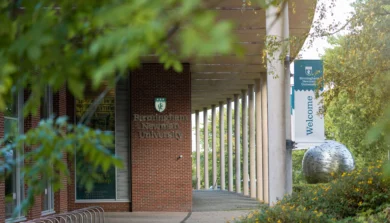
Exterior of Birmingham Newman with globe

Celebrating a Key Publication Supporting Entry-Level Students at Birmingham Newman University

Birmingham Newman University continues to reflect proudly on the publication of Essential Skills for Entry…
Birmingham Newman Celebrates Green Week 2026 with Campus‑Wide Events

Birmingham Newman will host its annual Green Week from 23 to 27 February 2026, bringing…

Book an open day

Find out about our next open day. Book now to secure your place.

Research Methods & Project Management
20 Credits (Compulsory)

This module introduces objectives and importance of research in Computer Science, systematic literature review, problem statement and hypothesis formulation, experiment design, identifying types of variables and data wrangling, sampling techniques, quantitative and qualitative research, mixed methods of research, data imputation, types of statistical tests and evaluation measures. The module also discusses ethical constraints, intellectual property rights and legal requirements. The students are expected to conduct data analyses and present reports in a variety of formats and visualizations.

Ai & Data Science Fundamentals
20 Credits (Compulsory)

This module develops the theoretical foundation and practical skills of artificial intelligence (AI) and data science (DS) and their applicability in real-world scenarios. Building upon the statistical and mathematical underpinnings, this module aims to teach students the established approaches, emerging trends and challenges in classification, regression and clustering tasks. A variety of machine learning approaches used in AI and DS applications are introduced and Python programming language (with open-source libraries) is suggested for developing practical solutions.

Dissertation
60 Credits (Compulsory)

Having studied core Computer Science topics, students have the opportunity to apply a range of conceptual knowledge and practical implementation tools to an in-depth development of a real-world project of their particular interest. The aim is to develop the skills expected at postgraduate level and equip Computer Science students with imperative knowledge, research & analysis skills, application of software development life cycle and critical insights into the process of transforming user requirements into practical software solutions.

Computer Vision
20 Credits (Compulsory)

This module develops the technical perspectives and practical knowledge of computer vision and its applications. Evolving as a confluence of image processing, artificial intelligence and machine learning, this module incorporates low- and high-level feature extraction from images and videos, implementation of statistical pattern recognition and generation of predictions and semantic analyses.

Topics include image characterises, processing in spatial and frequency domains, linear transformations, wavelet decomposition, feature detection and extraction, image registration, segmentation, motion estimation, probabilistic models of object detection and recognition, object tracking, scene labelling and context and scene understanding.

The practical implementation of state-of-the-art algorithms is done using Python (or Matlab) environment with relevant libraries such as OpenCV.

Natural Language Processing
20 Credits (Compulsory)

This module will provide students opportunity to understand and apply computational techniques to analyse and synthesize natural language and speech – Natural Language Processing (NLP). An interdisciplinary bridging of linguistics, information retrieval and machine learning will provide necessary skills to develop applications capable of comprehending, manipulating and generating natural language text and speech similar to Large Language Models.

This module will introduce topics in NLP including tokenization, stemming, parsing, lemmatization, basic text processing, linguistics and NLP tasks, Python NLTK library for NLP, text preprocessing and n-grams, Softmax / MAXENT (sequence) classifiers, sequence

classifiers for POS and NER, Deep learning-based word representations & deep networks

for NER, recurrent networks and language modelling, statistical machine

translation, word alignment, parallel corpora, decoding, evaluation, modern deep learning machine translation systems (phrase-based, syntactic), syntax and parsing, co-reference resolution, tree recursive neural networks for POS tagging, computational semantics, question answering, text summarization and dialogue systems.

High-Performance Computing (HPC) aspects will demonstrate how NLP can be leveraged on graphical processing units (GPUs) using Google TensorFlow and NLTK library. Focus is primarily upon the application of NLP to real-world problems, with some introduction to transformers and large language models, like ChatGPT, with practical exercises using.

Fundamentals of Networking and Cybersecurity
20 Credits (Compulsory)

This module entails the theoretical knowledge and practical skills of wired and wireless computer networks, Internet of Things and cyber security. Designed to introduce advanced communication concepts to both networking experts and non-experts, the module aims to enable students to design, develop, implement and secure networked systems.

Big Data Analytics
20 Credits (Compulsory)

This module develops the theoretical and practical skills of technology of Big Data – massive amounts of information that necessitate software systems and resources with significantly enhanced storage, communication and processing and analysis algorithms beyond the capabilities of traditional databases and OLAP. The module introduces the programming paradigm and mindset that are required in this emerging field.

Topics include statistical modelling and inference, populations and samples, probability distributions, exploratory data analysis, fitting a machine learning model, linear regression, k-Nearest Neighbours (k-NN), k-Means, Naive Bayes, dimensionality reduction, singular value decomposition, principal component analysis, artificial neural networks and deep learning models. Further discussions will include mining social-network graphs, clustering of graphs, direct discovery of communities in graphs, partitioning of graphs, neighbourhood properties in graphs, data visualization, ethical and legal issues.

An appreciation of programming paradigm, tools, techniques and algorithms supporting Big Data will provide necessary practical experience. Students will implement algorithms in Python with relevant libraries for big data gathering, storage, manipulation and analyses.

At Birmingham Newman University, you’ll enjoy the best of both worlds: a peaceful, green campus that creates the ideal setting for focused study and personal reflection, yet remains just eight miles from the vibrant city centre.

As the UK’s second-largest city, Birmingham is also one of the youngest and most diverse in Europe, offering a dynamic blend of culture, innovation and opportunity. From world-renowned museums and music venues to a thriving food scene alongside a growing business and tech sector, it’s a place where creativity and ambition naturally thrive.

Experience Birmingham: A City Full of Possibilities

Whether you're discovering the Midlands for the first time or already know the area well, Birmingham provides a lively and inclusive environment for students. As one of the most energetic and multicultural cities in the UK, it’s a place where you can grow academically while developing personally. Its rich cultural heritage, creative energy and broad range of opportunities make it an inspiring backdrop for your university journey.

A City That Loves Great Food

Birmingham is a brilliant place to explore diverse culinary experiences. You might wander through the famous Balti Triangle, sample global street food at Digbeth Dining Club or enjoy a relaxed meal by the canals in Brindleyplace. The city is also home to independent cafés, vegan-friendly eateries and countless hidden gems. Whether you're grabbing a quick bite between lectures or planning an evening out, there’s always something new to discover.

Arts, Culture and Entertainment

The city pulses with creativity. You could catch live music at the O2 Academy, experience a world-class performance at the Birmingham Hippodrome or browse exhibitions at the Birmingham Museum and Art Gallery. Creative spaces like the Custard Factory showcase local talent while hosting events that celebrate innovation. With festivals, sporting fixtures and cultural celebrations taking place year-round, there’s never a shortage of things to enjoy.

Simple & Convenient Travel

Getting around Birmingham is straightforward thanks to its well-connected public transport system. Buses, trams and trains make it easy to reach campus, explore the city or travel further afield. Whether you're commuting daily or heading off for a weekend adventure, transport is both accessible and affordable.

Life Beyond the Lecture Hall

Your time at Birmingham Newman University extends far beyond academic study. You’ll have the chance to join student societies, contribute to community projects or try something entirely new. The university’s supportive atmosphere encourages you to build confidence, develop practical skills and feel genuinely at home throughout your studies.

Graduates may pursue roles such as:
AI Engineer
Data Scientist
Applied Informatics Specialist
Researcher in AI
Product Manager for AI Tech Solutions
AI Engineer in Healthcare
Clinical Data Scientist
Health Informatics Specialist
Researcher in Biomedical AI
Product Manager for Health Tech Solutions


Courses we think you'll also like

Instagram does not support direct link sharing, below is the page URL to copy to add to Instagram posts manually: