MA Education (on campus)

Welcome to your Masters in Education!

We are delighted that you have chosen to study with us and look forward to getting to know you, and supporting you on your Postgraduate journey.

Below you will find key information about your course, but please get in contact with us if you have any further questions.

Timetable

First block teaching starts week beginning 19 January 2026:

  • Tuesdays: 10am to 12pm
  • Wednesdays: 10am to 12pm and 1pm to 3pm
  • Plus, research seminars on set dates Wednesdays: 4:30pm to 7pm

Full details of your individual academic timetable will be available via your university email calendar after you have completed online enrolment and set up your student login.

Induction day
  • Tuesday 13 January 2026 10am to 12pm and 1pm to 3pm (Room DW111)

Please come to the main reception for directions. You will be directed to Starbucks in the main atrium, visible from reception and DW111 is one of the few rooms opposite Starbucks, facing the Chaplaincy office.

The programme for the day will enable you to: meet and get to know your fellow students and staff; ensure you are registered so that you can access Library and Moodle resources.

You will find out more about how the MA Education on-campus will run; familiarise you with the university if you are new to it and also access pre-session reading and tasks for Week 1.

Wednesday afternoon academic toolkit sessions 1pm to 3pm will provide further support for your Masters study build on this introductory day.

IMPORTANT: Please bring your photo ID with you to complete the ID verification check for Student Finance confirmation.

Pre-arrival activities

A Masters course is a progression from undergraduate study and requires a higher level of independent study, persistent curiosity, criticality, reflection and layered analysis and synthesis. With this in mind, in preparation for your Masters study please ready yourself by

Semester one modules will require your attunement to contemporary concerns in education globally and to the kinds of evidence-based and theoretically argued educational practices that are being developed and tested globally.

Engaging with and thinking about contemporary educational issues and concerns in the press, in educational publications, across media.

Reading widely around the interests you have in education, using Open Access research articles, perhaps through Google Scholar.

Reading about research methods and Postgraduate study. You may have existing access to university libraries or use Open access sources on the internet.

Teaching team

You will have different module tutors across the year, and opportunity to engage with and learn from the wider Education and Childhood and Professional Studies team.

You will be working immediately in your first semester with:

  • Dr Jo Trowsdale (EPM730 Research Design: Methodology and Methods)
  • Miranda Barker and Andrew Edgar (EPM722 Inclusive Practices)

You may also work with others in the Education Childhood and Professional Studies team (Dr Steve Dixon, Dr Linda Enow, Dr Jane Beniston, Dr Kate Dudley) and across the school of education.

This might be through our Sharing Research sessions, workshops, as guest speakers in core modules, or as dissertation supervisor where you will have opportunities to hear about their specialisms as well as those of fellow research students.

Module delivery

Teaching is enquiry-based and collaborative. Your interests will be central to the assignment foci you choose. Modules will provide opportunity for you to identify and generate connections between theory and practice in relation to your foci. You will be facilitated to learn from and with peers, to investigate and explore both together and independently.

You will study five modules in total (4 x 30 credit / 300 hours study; 1 x 60 credit / 600 hours study):

Your first four (taught) modules run 10am – 12pm Tuesdays and Wednesdays throughout your first two semesters, with academic toolkit sessions on Wednesdays 1pm to 3pm.

There are also research sharing sessions on several Wednesdays 4:30pm to 7pm and a writing workshop session on a Thursday and an annual conference in July.

January – April

  • (Tuesday 10am – 12 noon) EPM722 Inclusive Practices will enable you to critically engage with the concept of inclusion with a focus on special educational needs and disability. You will develop a critical understanding of how structural and socio-culturally situated inequalities can affect young people’s access, participation and success in education and society and how different needs, such as SEND can affect pupils’ participation and learning. You will explore strategies to promote inclusive and supportive communities through evidence-based practices.
  • (Wednesday 10am – 12 noon) EPM730 Research Design: Methods and Methodology will enable you to develop a critical understanding of the principles underpinning an effective research design in education at master’s level. You will explore issues of research methodology, ethics and understanding in relation to your chosen field, to enhance and inform professional and/or academic practice. You will design a research project, which will include a framework for the collection and analysis/interpretation of primary data.

May – August

  • EPM725 Critiquing Education will explore how the lenses of philosophy, psychology and sociology of education can illuminate and deepen our own criticality in examining contemporary and critical issues of concern in education. You will consider how they can generate distinct and complementary lenses for thinking critically about contemporary, historical and global issues of collective and personal interest, deepening your skills in critical analysis.
  • EPM721 Pedagogy and Practice will engage you in a critical exploration of how learning happens and an investigation of the character and claims for diverse educational practices and pedagogies. Through a focus on the interrelated areas of learning, teaching and assessment you will engage with key theories and debates, analysing and reflecting on their relevance to your personal and professional interests.

September – December

EPM705 Research Project / Dissertation (double weighted) will involve some taught dissertation sessions, workshops and supervisions to support you to undertake and write-up your own research study.

Access services and support throughout your degree

At Birmingham Newman, you’re never alone. We’re here to support you at every stage, whether it’s academic guidance, wellbeing support, or career advice.

Here are some of the ways we can help:

If you’re unsure where to start or what support you need, just ask – we’re happy to help

Induction

  • Tuesday 13 January 2026

Teaching starts

  • Tuesday 20 January 2026

Subject Leader

Stay connected with OurNewman app

OurNewman is your go-to place for everything you need as a Birmingham Newman student. With the app, you can:

  • Receive personalised notifications about your course, timetable, and deadlines
  • Access to your files, emails, and course resources
  • Find support services and keep up to date with campus events

Student Handbook
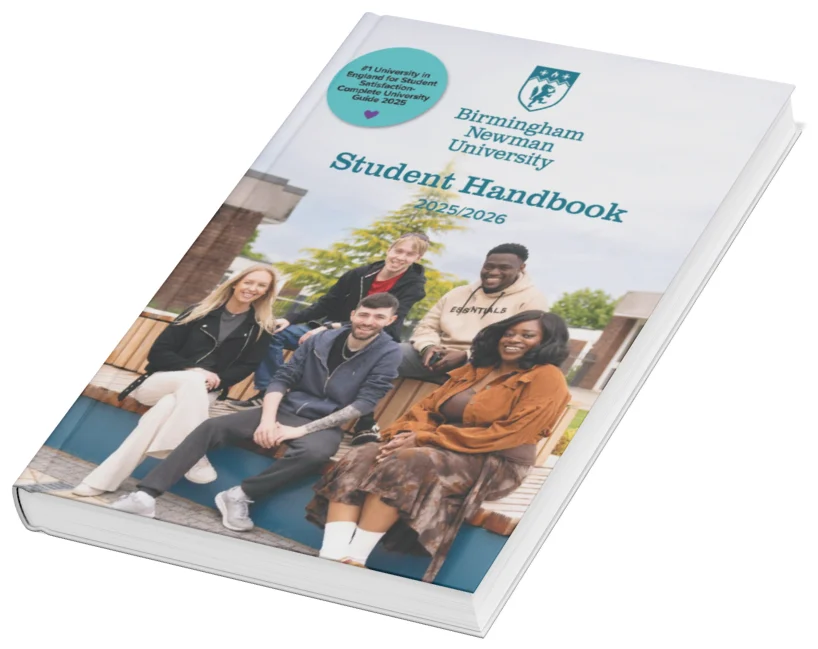
Student Handbook

Download (PDF – 3.68MB)

University of the Year for - Social Inclusion - Good University Guide 2026
What Uni - Student Choice Awards 2025 - University of the Year - West Midlands
Top 10 Student Satisfaction - NSS
Number 1 for student satisfaction - Complete University Guide

Instagram does not support direct link sharing, below is the page URL to copy to add to Instagram posts manually: