Click the Lost Password link to set a password when signing in for the first time
Enter your Newman student ID number (seven-digit number) and press Search
Your personal details will then be displayed. Check these details are correct and press send email
You will the receive a password recovery email to your personal email address. This will be an email from portal-admin@newman.ac.uk (please ensure to check your junk/spam folder)
Click on the link within the password recovery email and create a new password
Once you have set your password you will be logged into the applicant portal
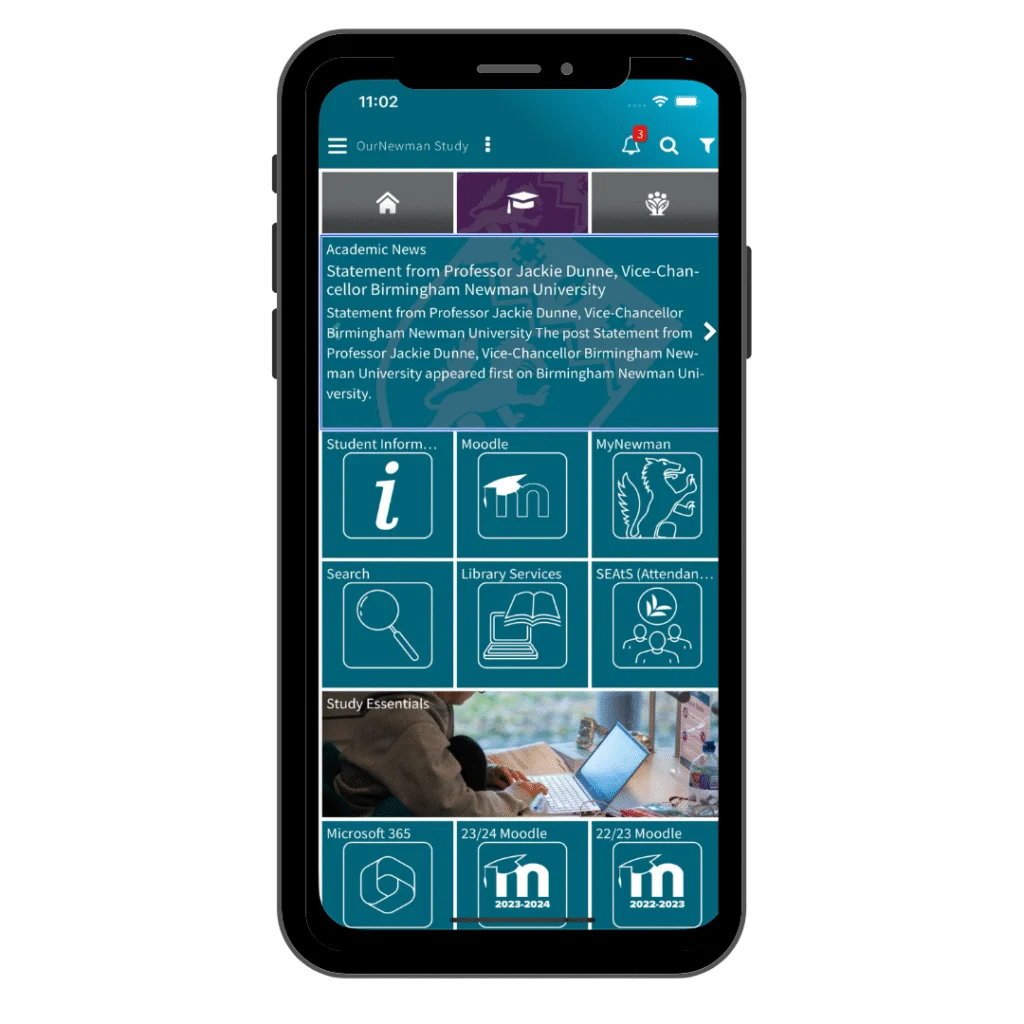
Click on the green box that says ‘My Newman for Applicants’
Once you’ve clicked on the green box, scroll down and click on the ‘Start Online Enrolment’ link underneath the ‘Online Enrolment’ tab
PLEASE NOTE: If you cannot see the Online Enrolment tab, please email registry@newman.ac.uk and they will be able to assist you further
Once you have completed your Online Enrolment, you will be emailed your Birmingham Newman email address (e.g. abcd123@newman.ac.uk) and instructions on how to log in and register for Multi Factor Authentication (MFA). This email will be sent to you within 24 hours after completing your online enrolment.
PLEASE NOTE: To log back into the applicant portal go to Moodle. Enter your Newman ID (7-digit number) and the password you have recently created.
Induction
Pre-induction
What Makes a Great Educator?
Welcome to the Education & Childhood programme. Before you begin your studies, we would like you to reflect on your understanding of the profession and the qualities that contribute to effective practice.
Task
Prepare a short reflection (approximately 300–500 words) or a one-page mind map addressing the following questions:
What qualities and skills do you think make an effective educator?
What experiences, interests, or motivations have inspired you to study Education and Childhood?
What knowledge, skills, or areas of practice would you like to develop during your degree?
Guidance
There are no right or wrong answers. We are interested in your personal perspectives and experiences. You may draw on:
Your own educational experiences.
Work, volunteering, or placement experiences with children and families.
Media, books, or articles that have influenced your thinking.
Current issues affecting children, families, and education.
Purpose
This task is designed to help you begin thinking about your professional identity as an educator and prepare for the discussion-based learning that forms a key part of the programme. We encourage you to bring your reflections to the first teaching session, where you will have the opportunity to share and discuss your ideas with peers.
Induction day
Tuesday 15 September
15:30 – 18:00
Room DW102
IMPORTANT: Please bring your photo ID with you on this date to complete enrolment.
Our induction is designed to introduce students to the Education and Childhood programme through interactive, discussion-based activities that reflect our approach to teaching and learning.
Students will have the opportunity to meet the teaching team and their peers, explore the role of the professional, discuss their pre-enrolment reflections, and engage with activities that connect research, theory, and practice.
The induction aims to foster a supportive learning community, encourage critical thinking, and help students begin developing their professional identity as future Educators.
Timetable
Timetable
Semester 1 starts week beginning 21 September
Tuesdays
13.00-20.30
Full details of your individual academic timetable, including Semester 2 timetable which may differ, will be available via your university email calendar after you have completed the pre-arrival task online and set up your student login.
Module delivery
Our modules are designed to be highly interactive and discussion-based, encouraging students to engage critically with key issues in Education and Childhood.
Through a blend of research-informed learning and practical application, students explore contemporary theories, policies, and practices while drawing on real-world examples from education and care settings.
Seminars, group discussions, case studies, and reflective activities provide opportunities to connect academic evidence with professional practice, fostering collaborative learning and the development of critical thinking skills essential for working with children and families.
Teaching team
The teaching team consists of university lecturers who bring a diverse combination of academic, professional, and practice-based expertise to the programme.
Most team members have previous experience within education, contributing valuable insights into teaching parctices, leadership, strategy, and organisational development, while another team member is a qualified ex social worker with extensive experience supporting children, families, and communities.
The programme is further enriched by contributions from a range of guest speakers, who provide current perspectives from educational practice. Together, the team is committed to preparing future educators through engaging teaching, research-informed learning, and exploration of contemporary issues in education and child development.
Help and support
Access services and support throughout your degree.
At Birmingham Newman, you’re never alone. We’re here to support you at every stage, whether it’s academic guidance, wellbeing support, or career advice.
By clicking play, you agree to load content from YouTube, which may collect data about your visit. YouTube’s privacy policy applies.
Disabled Student Allowance
Privacy Notice
By clicking play, you agree to load content from YouTube, which may collect data about your visit. YouTube’s privacy policy applies.
Advice & Wellbeing support
Privacy Notice
By clicking play, you agree to load content from YouTube, which may collect data about your visit. YouTube’s privacy policy applies.
Mental Health Support
Privacy Notice
By clicking play, you agree to load content from YouTube, which may collect data about your visit. YouTube’s privacy policy applies.
Student Money Advice
Privacy Notice
By clicking play, you agree to load content from YouTube, which may collect data about your visit. YouTube’s privacy policy applies.
HeadStart
HeadStart is a series of interactive workshops designed to help you feel confident, prepared and connected as you begin your university journey.
Covering everything from digital skills, Moodle and AI, to study techniques, library support, wellbeing, money advice and careers, the programme provides practical guidance to help you succeed both academically and personally.
By taking part, you’ll build essential skills, discover the support available to you, and make a positive start to life at university.
HeadStart schedule
Monday 7 September
On campus sessions
Online sessions
Monday 7 September (10am to 11am) – eLearning – Digital for your Studies – On campus – ST002
Monday 7 September (11am – to 12pm) – Student Engagement – How to manage your first four weeks – On campus – ST002
Monday 7 September (1pm to 2pm) – Learning Development – Study and Writing at University level – On campus – HI104
Tuesday 8 September
On campus sessions
Online sessions
Tuesday 8 September (10am to 11am) – Digital and Your Studies (Online)
Tuesday 8 September (11am to 12pm) – I’ve never used a library before!: What to expect in Newman Library (Online)
Wednesday 9 September
On campus sessions
Online sessions
Wednesday 9 September (11am) – Library – “I’ve never used a library before!”: What to expect in Newman Library – On campus – ST002
Wednesday 9 September (12pm) – Careers – Unlock your Future: Strengths, Options and Careers Service Intro – On campus – ST002
Wednesday 9 September (2pm) – Meet the Students’ Union: Your Guide to Student Life – Life Beyond the Lecture Theatre – On campus – HI104
Thursday 10 September
On campus sessions
Online sessions
Thursday 10 September (10am to 11am) – AI and your learning: getting the basics right (Online)
Thursday 10 September (12pm to 1pm) – Unlock your Future: Strengths, Options and Careers Service Intro (Online)
Thursday 10 September (1pm to 2pm) – Learning Development: Study and Writing at University level (Online)
Thursday 10 September (2pm to 3pm) – Sources for courses: a guide to reading expectations at University (Online)
Friday 11 September
On campus sessions
Online sessions
Friday 11 September (10am to 11am) – Money and Student Life (Online)
Friday 11 September (11am to 12pm) – Managing your wellbeing (Online)
Friday 11 September (1pm) – Student Money Advisor – Money and Student Life – On campus – ST002
Friday 11 September (2pm) – Advice & Wellbeing – Managing your wellbeing – On campus – ST002
Friday 11 September (3pm) – Library – Sources for courses: a guide to reading expectations at University – On campus – ST002
What to expect
Attendance monitoring
At Birmingham Newman University we use SEAtS Software to monitor attendance and engagement in order to support students to achieve success.